| Garantie LCD/Backlight (Jahre): | 3 Jahre bedingter Vor-Ort-Austauschservice |
| max. Pixelfehler (nach ISO 13406-2): | Klasse II |
| Panelgröße [Zoll]: | 22 |
| Pixelgröße [mm]: | 0.282 |
| Standardauflösung: | 1.680 x 1.050 (16:10) |
| Sichtbare Bildgröße/-diagonale [mm]: | 474 x 296 / 558 |
| Eingänge, Stecker: | 1 x D-Sub (analog), 1 x DVI-D (digital) |
| Bildfrequenz [Hz]: | 50 – 75 |
| max. Zeilenfrequenz/Videobandbreite [kHz/MHz]: | 24 – 82 / 137,6 |
| Farbmodi Preset/User: | 5 / 1 |
| LCD drehbar/Portrait Modus: | Nein / Nein |
| LCD Display Arm Option: | Ja |
| Ausstattung: | Netzkabel, DVI-D-Kabel (Dual-link), D-Sub HD15, 3,5-mm-Klinkenstecker (Audio), eingebaute 2-Watt-Lautsprecher (SRS/WOW/HD-Stereo), Handbuch und Software (Viewsonic Assistent) auf CD, gedruckte Kurzanleitung |
| Monitormaße (B x H x T) [mm]: | 509 x 359 – 441 x 203 (mit Fuß) |
| Gewicht [kg]: | 7,78 |
| Prüfzeichen: | BSMI, CCC, PSB, C-Tick, KCC,CE, Gost-R/Hygienic, Ukraine, MPR II, ISO 13406-2, SASO, TUVdotcom, UL/cUL, FCC-B, ICES-B, TUV-S/UL-AR S Mark, NOM, Energy Star |
| Leistungsaufnahme On/Stand-by/Off [Watt]: | 49 / – / 1 (Herstellerangabe) |
Einleitung
„Extreme 3D“ lautet das Attribut, das Viewsonic seinem 22-Zoll-TFT VX2268wm verleiht – die Richtung ist damit vorgegeben. Der 120-Hertz-Monitor soll zusammen mit Nvidias stereoskopischer 3D-Brille für Furore in der Spielergemeinschaft sorgen.
Seine Fähigkeit zur dreidimensionalen Darstellung erhält der Monitor im Zusammenspiel mit einer 3D-Shutter-Brille des 3D-Vision-Kits von Nvidia und folgenden kompatiblen Grafikkarten: Geforce 8000er Serie (8800GT oder höher), Geforce 9000er Serie (9600GT oder höher) und alle Pixelbeschleuniger der Geforce GTX2xx-Serie.
Die Arbeitsweise des Monitors lautet: Zerlegen. Gemeint ist das Signal, und zwar in einzelne Bilder für das linke und das rechte Auge mit einer Bildwiederholfrequenz von jeweils 60 Hertz. 60 Hertz entsprechen der Frequenz herkömmlicher Monitore. Jedes Auge bekommt nun ein Bild nacheinander zu sehen – linkes Auge: Bild 1, 3, 5; rechtes Auge: Bild 2, 4, 6. Das Gehirn setzt diese Wechselbilder derart zusammen, dass sich ein dreidimensionaler Effekt ergibt.
Das von der Brille übernommene Verdunkeln (Englisch: to shut) der jeweiligen anderen Seite erklärt auch, warum der Monitor 120 Hertz Bildwiederholfrequenz beherrschen muss. Ein Standard-LCD könnte nicht genug Wiederholrate liefern, als dass eine Bewegung auf dem Monitor für beide Augen flüssig und flimmerfrei genug erschiene.
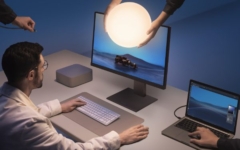
Die Brille benötigt kein Kabel; aufgeladen wird sie über einen integrierten USB-Anschluss. Eine im Lieferumfang enthaltene Box, der Sender, aktiviert den 3D-Effekt und erlaubt es, die Stärke des 3D-Effektes einzustellen. Dieser Test beschränkt sich allerdings nur auf den Monitor als solchen.


Auch ohne seine Fähigkeit zur „echten“ 3D-Darstellung zu berücksichtigen, deuten die Herstellerangaben und Spezifikationen des VX2268wm auf einen multimediatauglichen und spielefähigen Monitor hin: 20.000:1 beträgt das dynamische Kontrastverhältnis (1.000:1 statisch), die Reaktionszeit ist mit zwei Millisekunden angegeben und die integrierten Stereolautsprecher lassen ebenfalls auf einen gewissen Anspruch hinsichtlich der Multimediawiedergabe schließen.
Ob das 1.680 x 1.050 Bildpunkte darstellende TN-Display seine vom Hersteller angegebenen Werte bestätigen kann und wie es sich im herkömmlichen Spielebetrieb, aber auch in zweidimensionalen Anwendungen schlägt, ergründen wir für Sie im folgenden Test.
Alle im Test veröffentlichten Ergebnisse wurden am digitalen Ausgang einer Nvidia Geforce 8800GT 512 (G92) von Sparkle ermittelt; die Videowiedergabe und Spieletauglichkeit wurden mit einem PC über DVI überprüft.
Die externe Zuspielung von Videomaterial übernahm der Sony BDP-S 360 Blu-ray-Player, angeschlossen über ein DVI-auf-HDMI-Kabel. Weil der DVI-Eingang des Viewsonic VX2268wm die Wiedergabe von HDCP-kopiergeschütztem Material verweigert, musste auf Blu-Ray-Zuspielung verzichtet werden. Für die Farbraummessungen und zum Kalibrieren kam ein EyeOne-Display2-Kolorimeter von Gretag Macbeth in Zusammenspiel mit der iColor-Display-Software, Version 3.5.0.0 zum Einsatz. Um den Input-Lags zu bestimmen, wurde schließlich die Software SMTT verwendet.
Lieferumfang
Auffällig bedruckt präsentiert sich der Karton des VX2268wm. Wer anhand der Verpackungsmaße auf die Monitorgröße schließt und glaubt, er würde sogleich einen TFT der eher voluminösen Sorte auspacken, der irrt jedoch. Obwohl mit 6,5 Zentimeter Bautiefe nicht der schlankeste, ist der Viewsonic in keiner Hinsicht überdimensioniert. Statt seitlicher Grifflaschen ist in den Deckel des Kartons ein Tragegriff eingelassen, mit dessen Hilfe sich die knapp acht Kilogramm Bruttogewicht des Monitors bestens bewältigen lassen.

Entgegen allen aktuellen Tendenzen, Umverpackungen klein, schlicht (und weitgehend recycelbar) zu halten, verpasst Viewsonic dem VX2268wm einen so reichlich dimensionierten und farblich auffälligen Karton, dass man in ihm ein wahres Ungetüm von einem Monitor vermutet.



Monitor und Standfuß sind werksseitig fest verbunden; nur die Bodenplatte befindet sich einzeln im Karton. Der sehr üppig dimensionierte Karton ist also nur zu kleinen Teilen den physischen Ausmaßen des Viewsonic geschuldet. Hauptgrund ist die wirkliche dicke Styroporumverpackung und der Umstand, dass die nicht vormontierte Bodenplatte ebenfalls Platz benötigt.
Gehäuse und Bodenplatte sind im Karton durch eine Styroporschicht getrennt, die das Zerkratzen des Displays verhindern soll. Beide Einzelteile befinden sich zusätzlich in einer Plastikhülle – so sind die empfindlichen Hochglanzoberflächen vor Kratzern geschützt. Ebenso obligatorisch: die über das Panel geklebte Kunststoffauflage sowie die selbstklebende Folie auf allen glänzenden Oberflächen – der VX2268wm ist optimal und überaus sicher verpackt.
Unkompliziert gestaltet sich die Montage der Bodenplatte. Das Gehäuse muss mit dem fest verbauten Standfuß in die spindelförmige Platte eingeklickt werden und wird zusätzlich mit einer Schraube befestigt. Im Ergebnis hat der Monitor auf dieser Konstruktion einen sicheren, wenn auch nicht gänzlich festen Halt. Sein seitliches Spiel ist jedoch straff und in engen Grenzen. Auch ohne die Sicherungsschraube vermittelt die Steckverbindung einen stabilen Eindruck, was zweifellos dem Eigengewicht des TFTs geschuldet ist.


Weiterhin befinden sich im Lieferumfang ein D-sub-VGA-Kabel für den analogen und ein DVI-Kabel für den digitalen Anschluss an den PC. Weil der VX2268wm über ein eingebautes Netzteil verfügt, braucht es lediglich noch ein Netzkabel; auch das gehört zur Grundausstattung. Ein 3,5-Millimeter-Klinkenkabel zur Audiowiedergabe über die bordeigenen Stereoboxen rundet das kabelbasierte Zubehör ab.

Hinzu kommen in gedruckter Form der Quick-Start-Guide, die kleine Auf- und Abbauanleitung und ein Hinweiszettel zur Installation der SRS-Premium-Sound-Software. Dieses Programm, die Monitortreiber und ein mehrsprachiges Handbuch befinden sich auf der beigelegten CD.