Als Pulldown bezeichnet man den Prozess, der beim Übertragen eines Films auf NTSC-Video stattfindet. Der Kinofilm hat weltweit einheitlich 24 Frames per Second (FPS) oder kurz 24p: NTSC arbeitet mit 30 Halbbildern, also 30 FPS. Das PAL-Bild hat 25 Halbbilder, also 25 FPS. Entsprechend ist der Prozess des Videotransfers bei beiden Normen unterschiedlich.
Bei NTSC werden aus jedem Kinobild abwechselnd zwei oder drei Halbbilder erzeugt. Das Ergebnis wird noch leicht verlangsamt und erzeugt dann die ca. 60 Halbbilder der NTSC-Norm. Dadurch entstehen Bewegungsfehler in der Videoversion, die allerdings vom ungeschulten Betrachter nicht bewußt wahrgenommen werden.
Bei PAL ist das Verfahren anders und ist eher ein „2:2-Pulldown“: Hier wird der Film um etwa 4% beschleunigt, so dass er mit 25 statt mit 24 Bildern pro Sekunde läuft. Die beschleunigten Bilder werden in je zwei Halbbilder („2:2-Pulldown“), also 50 pro Sekunde, zerlegt. Die Video-Version wird damit je nach Spielfilmlänge etwa 5 Minuten kürzer als das Original. Durch die Stauchung werden die Frequenzen von Sprache und Musik leicht nach oben angehoben, allerdings in so geringem Maße, dass dies nur Betrachtern mit sehr geschultem Gehör auffallen dürfte.
Was bedeutet 3:2 Pulldown?
Originäres Ziel des 3:2 Pulldown ist die Erzeugung eines broadcastfähigen TV-Signals mit 60 Hz im NTSC Einzugsgebiet. Diverse Abspielgeräte (DVD-, HD-DVD-, Blu-ray-Player) können den 3:2 Pulldown selbständig bei vorliegender Filmquelle durchführen. Am Ende steht auch hier ein 60 Hz-Signal.
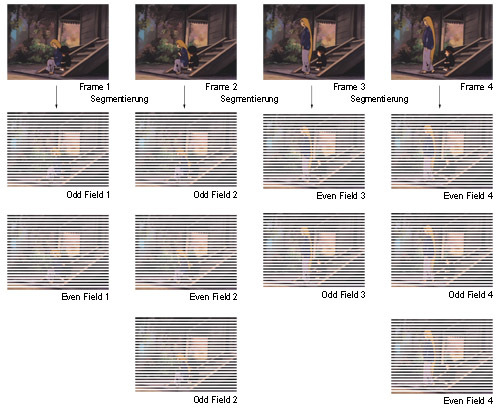
Das zugrunde liegende Filmmaterial, mit 24 Vollbildern pro Sekunde, wird in einem 3:2 Rhythmus segmentiert (d.h. in Halbbilder aufgeteilt). Das erste Vollbild in zwei Halbbilder, das zweite Vollbild in drei Halbbilder (wobei das Dritte eine Wiederholung des Ersten ist) und das Dritte wiederum in zwei Halbbilder usw. Daraus ergeben sich 60 Halbbilder pro Sekunde, also die gewünschte, broadcastfähige Frequenz. Man spricht auch von einem Signal mit einer 3:2 Kadenz. Nachteil dieser Verarbeitung ist eine Veränderung des Bewegungseindruckes, da das Verteilungsschema nicht linear ist. Ein leichtes Bildruckeln ist die Folge.
Da Flachbildschirme auf Vollbildbasis arbeiten, muss ein entsprechendes Signal vor der Anzeige deinterlaced werden. Ausgereifte Lösungen erkennen die vorliegende Kadenz und sind damit in der Lage, die originalen Vollbilder wiederherzustellen. Ein ruckelfreies 24 Hz-Signal ist das Resultat. Dieser Vorgang wird auch als „Inverse Telecine“ bzw. „Reverse Pulldown“ bezeichnet. Leider sind die Deinterlacer vieler Fernseher in dieser Hinsicht oft nicht stabil genug in der Erkennung. In der Folge behandeln sie das Material wie Video (echte 60 Halbbilder pro Sekunde), so dass im Ergebnis 60 Vollbilder pro Sekunde entstehen (die nicht die Orginalqualität erreichen). Oder die zurückgewonnenen Vollbilder werden in einem „ungeeigneten“ Rhythmus (z.B. 3:2) zum Panel weitergereicht, um eine Ansteuerung mit 60 Hz zu ermöglichen. In beiden Fällen leidet der Bewegungseindruck.
59,84 Hz zu 60 Hz – nur eine kleine Abweichung?
Bislang war von einem 60 Hz-Signal die Rede. Tatsächlich wird im Broadcastbereich mit 59,84 Hz gearbeitet. Um diese Frequenz zu erreichen, wird das Filmmaterial vor dem 3:2 Pulldown minimal auf 23,976 Vollbilder pro Sekunde verlangsamt. Das ist meistens auch die Basis für NTSC-DVDs sowie die neuen HD-Medien.
Im PAL-Einzugsgebiet hat der 3:2 Pulldown bislang kaum Bedeutung, da hier mit 50 Hz-Signalen gearbeitet wird. Hier findet für Filmmaterial der PAL-Speedup mit 2:2 Pulldown Anwendung. Eine Ausnahme bilden die neuen HD-Medien (HD-DVD, Blu-ray). Hier wird Filmmaterial mit 24 Vollbildern pro Sekunde gespeichert. Die playerseitige Ausgabe kann meistens mit 24 Hz (also 1:1) oder 60 Hz (durch den beschriebenen 3:2 Pulldown) erfolgen.