| Garantie LCD / Backlight (Jahre): | 3 inkl. Vor-Ort-Austauschservice (Premium Austausch) |
| max. Pixelfehler (nach ISO 13406-2): | Klasse II |
| Panelgröße [Zoll]: | 24 |
| Pixelgröße [mm]: | 0.270 |
| Standardauflösung: | 1.920 x 1.200 (16:10) |
| Sichtbare Bildgröße / -diagonale [mm]: | 518 x 324 / 518,4 |
| Eingänge, Stecker: | 2 x DVI-D (digital), 1 x DisplayPort (digital), 1 x HDMI (digital), 1 x D-Sub-VGA (analog), 1 x YPbPr, 1 x Composite |
| Bildfrequenz [Hz]: | 56 – 76 |
| max. Zeilenfrequenz / Videobandbreite [kHz/MHz]: | 30 – 81 /162 |
| Farbmodi Preset/User: | 7/1 |
| LCD drehbar/Portrait Modus: | Ja / Ja |
| LCD Display Arm Option: | Ja |
| Ausstattung: | 1 x DisplayPort Kabel, 1 x DVI-D-Kabel, 1 x D-Sub-VGA-Kabel, USB-Kabel, CD mit Anleitung, diverse Faltblätter (u.a. Kurzanleitung) und Information über Werkskalibrierung |
| Monitormaße (B x H x T) [mm]: | 560 x 393 – 493 x 201 (mit Fuß) |
| Gewicht [kg]: | 8,9 (mit Fuß) |
| Prüfzeichen: | TÜV GS, EN60950, CE, TÜV Ergonomie, ISO 13406-2, TCO 03 |
| Leistungsaufnahme On/Stand-by/Off [Watt]: | < 132 / < 1 / < 1 (Herstellerangabe) |
Einleitung
Erwartungsvoll haben viele ein Auge auf den Dell U2410 mit 24 Zoll Bildschirmdiagonale geworfen, der von den technischen Daten und auch vom Preis mehr als interessant ist. Seine bekannten Vorgänger 2405FPW, 2407WFP und 2408WFP konnten durchaus überzeugen und waren anfangs mit 1.300,00 Euro in der oberen Mittelklasse angesiedelt. Im Laufe der Jahre sind die Preise deutlich gefallen und der U2410 ist mittlerweile für unter 500,00 Euro zu haben.
Mittlerweile wird auch ein H-IPS-Panel verbaut, beim 2407WFP und 2408WFP waren es noch S-PVA-Panels. Ab dem 2407WFP-HC gibt es auch einen erweiterten Farbraum und auch die Ausstattungsmerkmale zeigen, dass Dell immer versucht auf dem neuesten Stand der Technik zu bleiben.
Das Panel ist baugleich mit dem HP LP2475W, kommt im Dell aber in einer leicht veränderten Version (Revision B) zum Einsatz. In der Vergangenheit gab es Beschwerden über grün/pinke Streifen und Dithering. Eine aktualisierte Firmware soll diesen Umstand aber beheben. Der HP LP2475W wurde schon vor einer Weile von PRAD getestet und wir sind gespannt auf die Ergebnisse des Dell U2410, der uns in der Revision A00, aber mit aktualisierter Firmware „M1F191“ vorlag, die auch in der neuesten Revision A01 zum Einsatz kommt.


Der Monitor hat eine maximale Auflösung von 1.920 x 1.200 Pixel (WUXGA) mit einem Seitenverhältnis von 16:10, was für einen normalen Desktop-Betrieb mehr als ausreichend ist. Die 24 Zoll reichen um zwei DIN-A4-Seiten nebeneinander darzustellen. Durch den HDMI-Anschluss kann ein externer Player oder eine Konsole angeschlossen werden und Full-HD Inhalte dargestellt werden.
Getestet wurde im PC-Betrieb mit einer ATI Radeon HD 4800er und im Mac-Betrieb mit einer NVIDIA GeForce 9600M GT. Gemessen wurde mit einem X-Rite i1 Pro Spektralphotometer und der Quato iColor Display-Software, sowie Eye-One Match. Zum Anschluss an den Rechner wurden sowohl DVI, VGA, DisplayPort als auch HDMI getestet.


Lieferumfang
Der Monitor ist gut verpackt und es ist in einer Schnellanweisung eindeutig beschrieben, wie er montiert wird. An Kabeln finden wir ein Netzkabel, ein DVI-Kabel, ein Displayport-Kabel (kein Minidisplayport), ein am Monitor angebrachtes VGA-Kabel, ein USB-Upstream-Kabel, Treiber und Dokumentations-CD und einen Farbkalibrationsbericht, der für jedes Modell individuell erstellt wurde.


Optik und Mechanik
In den Verstellmöglichkeiten kann der Dell U2410 ganz vorne mitspielen. Die Höhenverstellbarkeit ist perfekt ausbalanciert und mit dem kleinen Finger zu erledigen, der Monitor hat einen Verstellbereich von 10 cm und kann bis ca. 5 cm Abstand Unterkante zum Tisch abgesenkt werden.


Außerdem verfügt er über eine Pivot-Funktion und eine einstellbare Neigung von 3 Grad nach vorne bis 21 Grad nach hinten. Der Monitor bzw. Standfuß lässt sich auch um 45 Grad nach links oder rechts drehen.


Der Standfuß ist massiv gebaut, hat eine große Standfläche von ungefähr einem DIN-A4-Blatt und ist aus Metall, nur die Abdeckungen sind aus Plastik. Mit einem Schnappmechanismus lässt sich der Monitor leicht vom Standfuß lösen und an eine VESA-Halterung anbringen. Der silberne Mittelteil aus Metall hat eine zentrale Aussparung und kann als Kabelmanager genutzt werden.


Die Verarbeitung ist außerordentlich gut und lässt keine Wünsche offen. Der Monitor ist mit einem matten Display ausgestattet, welches so gut wie keine Reflexionen zulässt und außerdem noch 3H hartbeschichtet ist. Auch das Gehäuse ist matt und wirkt hochwertig, es sind nur wenig Spiegelungen an den inneren Seitenrändern zu erkennen. Von vorne wird der Monitor von einem 18 mm Rahmen umgeben, unten in der Mitte steht das Dell Logo (Breite 3 cm) und rechts leuchtet der Power-Schalter, alle anderen Bedientasten leuchten erst auf, wenn wenn man sich mit der Hand nähert. Insgesamt also recht minimalistisch und erfreulicherweise auf das Wesentliche reduziert.


Auf der linken Seite in der Mitte befindet sich eine ausziehbare Karte für den technischen Support auf der Modellnummer, Herstellungsdatum, Seriennummer mit EAN-Code und Revision, sowie Herstellungsländer vermerkt sind.

Mit einem optionalen Kabelschloss steht ein Diebstahlschutz zur Fixierung von Standfuß und Monitor zur Verfügung.
Das Netzteil ist integriert und läuft geräuschlos, wird die Helligkeit unter einem Wert von 10 gesetzt ist ein vorübergehendes Fiepen zu hören, was aber nach einiger Zeit völlig verschwindet. Es ist aber auch eine Serienstreuung zu erwarten. In Verbindung mit einem normalen PC wird dieser die Geräusche auf jeden Fall überbieten und selbst mit einem Silent-PC sollten diese nicht zu hören sein.



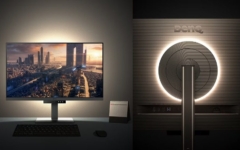
Integrierte Lautsprecher sind nicht zu finden, es kann aber eine optionale Soundbar für ca. 35,00 Euro dazugekauft werden, ein Audioausgang und eine Stromversorgung sind vorgesehen.